Boldly Going Tiny: Size Fetish Themes Across Star Trek
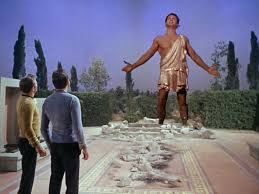
For fans of shrinking men, giant beings, and the delicious thrill of radical size difference — Star Trek has been quietly feeding the fantasy for over fifty years.
There's something irresistible about the idea of a 23rd-century starship, bristling with technology and crewed by the best minds in the galaxy, suddenly rendered helpless by a single change in scale. Whether it's a crew shrinking to the size of insects, a god-like giant casually holding an entire vessel in his palm, or an omnipotent being reducing a starship to Christmas ornament size on a whim — Star Trek has returned to size-play themes again and again across its many incarnations. Here's a guide to every unmissable episode and film for fans of macro/micro dynamics, giants, and shrinking men.
The Original Series: Where It All Began
"Who Mourns for Adonais?" (TOS Season 2, Episode 2 — 1967)
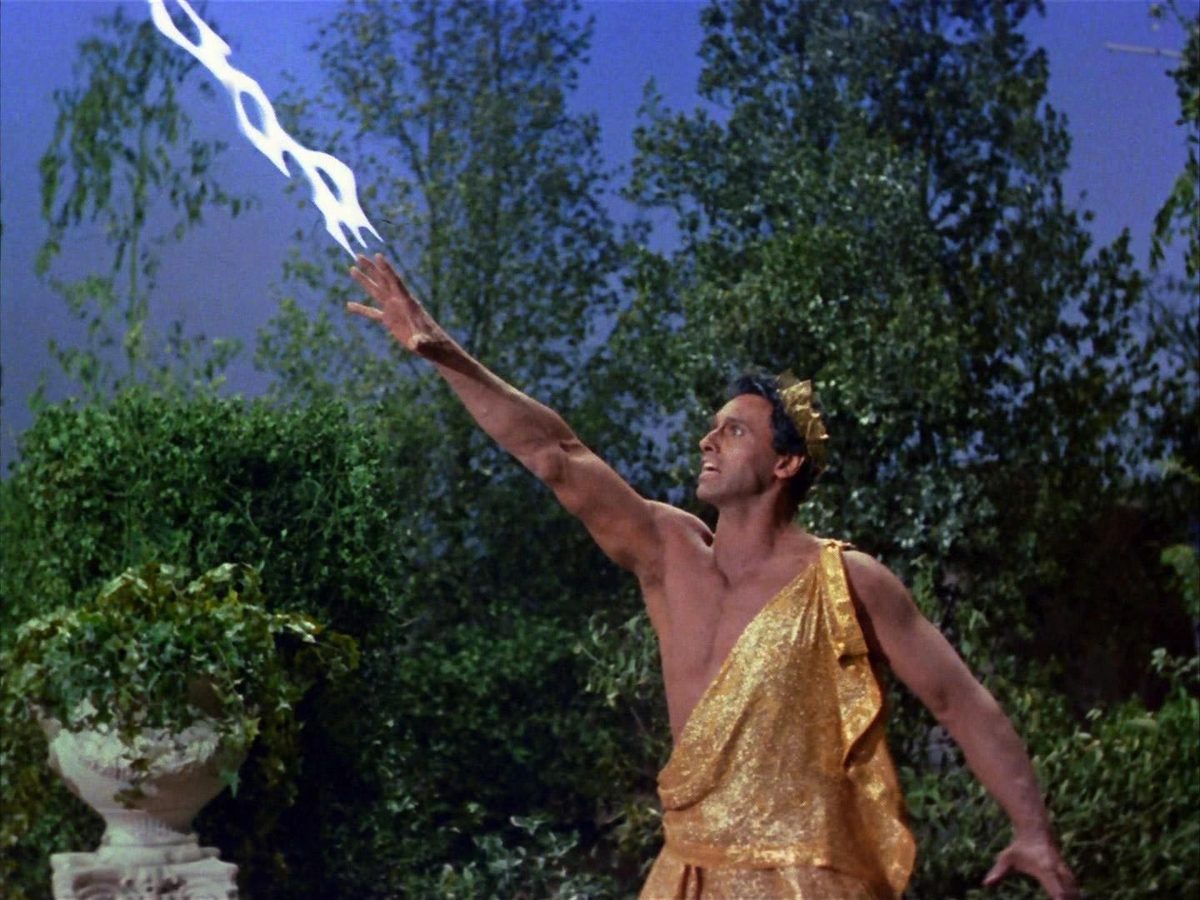
This is the granddaddy of Star Trek size fantasy, and it remains one of the most viscerally compelling examples in the entire franchise.
As the Enterprise nears Pollux IV, a colossal glowing green hand — made entirely of energy — materialises in space and seizes the ship. The crew cannot move. The helm doesn't respond. They are utterly in the grip of something that dwarfs them entirely. The hand belongs to Apollo, an alien who once visited Earth and was worshipped as a Greek god — and he hasn't lost the habit of expecting worship.
Apollo appears before the landing party as a normal-sized humanoid, but when challenged, he expands to a towering height of around twenty feet. The size dynamic here is pure power play: a being so far above the crew in scale that he treats them as pets, children, or playthings to be collected and kept.
The dialogue is dripping with the fantasy's core dynamic:
"I want from you that which is rightfully mine — your loyalty, your tribute, and your worship."
And when Kirk finally refuses, Apollo's wounded dignity and his slow, mournful dissolution are genuinely moving. His last words — "There is no room for gods" — echo plaintively as he fades from existence. It's an episode about power, scale, and the longing of a giant to be wanted by those smaller than himself.
The Animated Series: Going Full Size-Change
"The Terratin Incident" (TAS Season 1, Episode 11 — 1973)
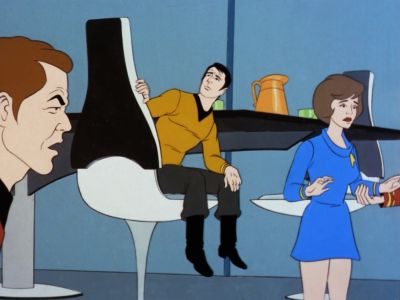
Star Trek: The Animated Series — often overlooked — contains some of the franchise's most unabashed size-change content, and "The Terratin Incident" is the jewel in the crown.
While investigating a burnt-out supernova, the Enterprise is hit by a beam of "spiroid epsilon waves" that shatters the dilithium crystals and triggers something far stranger: the entire organic crew begins to shrink. Not just a little — Spock calculates they will shrink by a factor of 32.9, which would reduce a six-foot person to approximately two inches tall.
The progression is beautifully rendered. At first, the crew think the instruments are growing. Then the awful truth dawns. Controls become harder to reach. Sulu tumbles from the navigation console and breaks his tiny leg. Nurse Chapel, now minuscule, falls into a fish tank and has to call for help. The ship's controls tower above them like an alien landscape. Everything familiar has become enormous.
McCoy explains the physics — the spacing between molecules decreasing, which means the crew retain their mass but are now far denser and smaller. The macabre detail that they become heavier for their size adds a strange, intoxicating layer to the shrinking.
Kirk beams down to the planet surface (the transporter restores him to normal size) and discovers the mystery: the Terratins, descendants of Earth colonists who have themselves evolved into tiny beings due to prolonged exposure to the same radiation, have been trying to make contact. The final image — Kirk returning to a ship crewed by people he can barely see — is the episode's most striking size-fantasy tableau.
"The Infinite Vulcan" (TAS Season 1, Episode 7 — 1973)
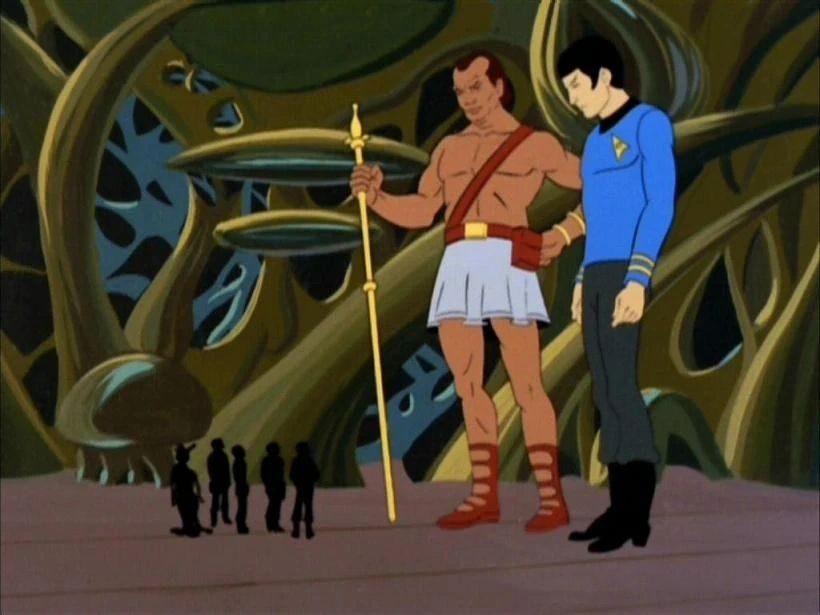
Written by Walter Koenig (Chekov himself), this episode flips the dynamic from small to impossibly large.
On the newly discovered planet Phylos, the crew encounters Keniclius Five — a giant clone of a 20th-century human scientist, standing many times the height of a normal human. Keniclius Five's plan is to create an army of giant clones to impose peace on the galaxy. To that end, he abducts Spock and clones him — creating Spock Two, a towering duplicate of the Vulcan.
The giant Keniclius's threat to Kirk is wonderfully blunt: "Spock is mine now. Go back to your ship or something bad will happen to you — I'll, I dunno, I'll step on you. Get lost." The casual contempt of the very large for the very small is the entire fantasy compressed into one throwaway line.
"More Tribbles, More Troubles" (TAS Season 1, Episode 5)
A more playful entry: in this sequel to the classic TOS episode, tribbles are genetically modified so that instead of multiplying endlessly, they simply grow. The result is tribbles that become enormous, lumbering creatures — adorable pets transformed into something that dwarfs their owners. Size change played for comedy, but size change nonetheless.
Deep Space Nine: The Ultimate Micro Fantasy
"One Little Ship" (DS9 Season 6, Episode 14 — 1998)
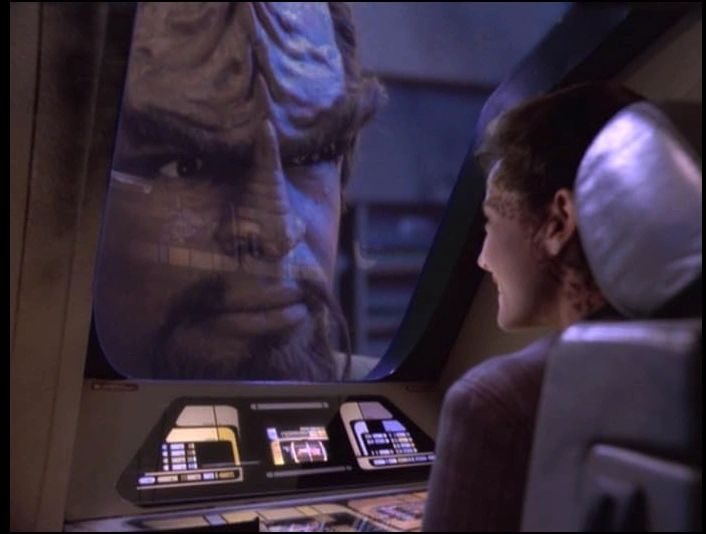
This is, without question, the most explicitly size-fetish-coded episode in all of Star Trek — and the writers clearly knew exactly what they were doing.
Dax, O'Brien, and Bashir take the runabout Rubicon into a rare subspace compression phenomenon. The anomaly miniaturizes the ship — and everyone aboard — to a tiny fraction of their normal size. When Jem'Hadar forces attack and board the Defiant, the three tiny officers must navigate their miniaturized vessel inside the full-sized ship to help retake it.
The size difference is used for maximum dramatic and comedic effect. The tiny Rubicon squeezes through plasma conduits. The shrunken crew stare up at Jem'Hadar soldiers the way humans might look at skyscrapers. The episode's tone is playful but the imagery is pure size fantasy — tiny figures navigating a giant, hostile world that was recently their normal home.
The dialogue is packed with knowing size jokes:
"Chief, you're not going to like this."
"I do not see what is so humorous about being small." "I'm sorry. It was very small of me."
O'Brien — who was nervous about entering the anomaly from the start — gets the most mileage, as the biggest size-related jokes land squarely at his expense. The climax sees the tiny runabout flying directly at a Jem'Hadar soldier and firing a miniature torpedo into his chest — the ultimate expression of the small asserting power against the enormous.
The episode is such an affectionate homage to the "Honey, I Shrunk the Kids" genre that fans have literally titled reviews "Honey, I Shrunk the Ship."
Voyager: The Series That Keeps on Giving
"Parallax" (VOY Season 1, Episode 3 — 1995)
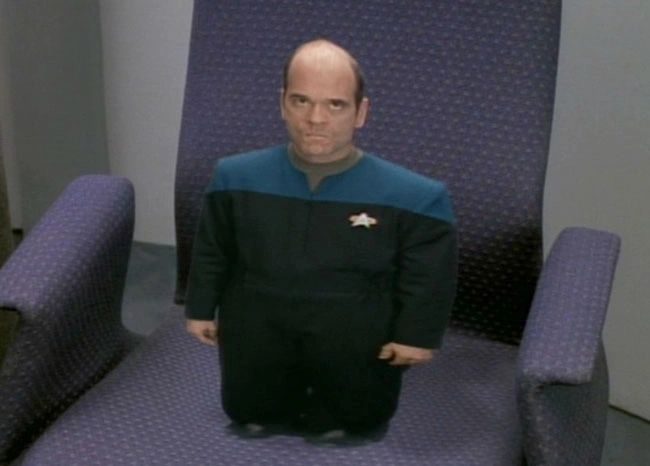
Voyager's very first season contains a size-change subplot that's easy to miss if you're focused on the episode's main story (the ship trapped in a quantum singularity), but unmistakable once you know to look for it.
The Doctor — Voyager's holographic EMH — experiences a malfunction in his imaging projectors as a side effect of the spatial anomaly. The result: he gradually shrinks in height throughout the episode. His delivery of the news to the crew is wonderfully deadpan:
"By the way, I am now 68 cm shorter. I'd appreciate it if someone would repair my holographic projectors before I have trouble reaching my patients."
It's played for laughs, but the image of the already-imperious Doctor getting smaller and smaller while maintaining his full dignity — and his full self-regard — is a genuinely charming piece of size-change storytelling.
"Death Wish" (VOY Season 2, Episode 18 — 1996)
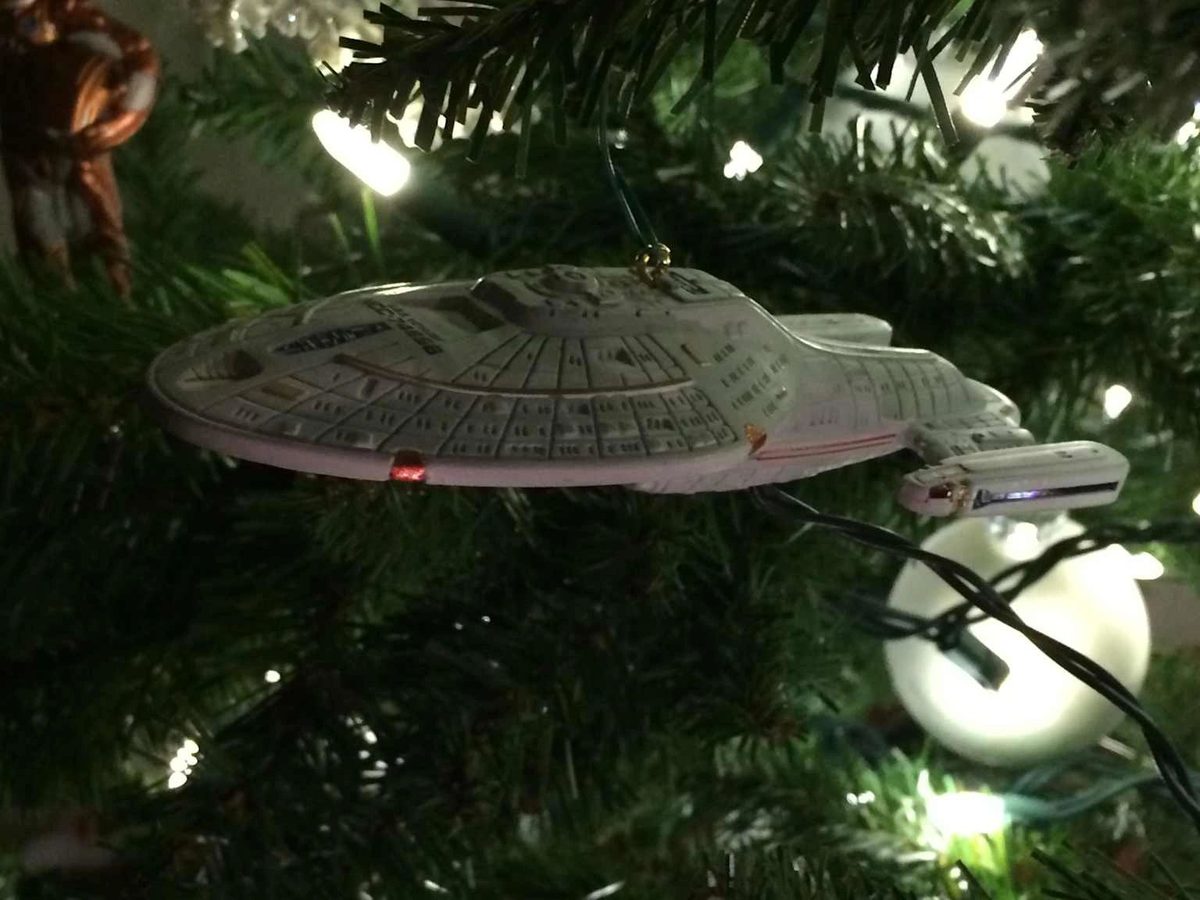
Q arrives on Voyager with another Q (later named Quinn) in tow, and to demonstrate his omnipotent power, he takes the entire crew on a tour of his "hiding places." One of these is particularly memorable: Q shrinks Voyager and hangs it as a Christmas tree ornament.
The crew look out through the viewscreen at enormous planetary ornaments hanging around them in the dark, and at Q himself — now titanic in scale — peering in through the viewport at his tiny captive vessel. The scene was such a fan favourite that Hallmark released an actual USS Voyager Christmas ornament later that same year, directly inspired by the episode.
The scene perfectly encapsulates the fantasy: the casual, almost playful power of someone so enormous they can reduce an entire starship full of people to a decoration. Q doesn't do it out of cruelty. He does it because, to him, the difference in scale is simply not significant.
The Hirogen: Giants Who Hunt
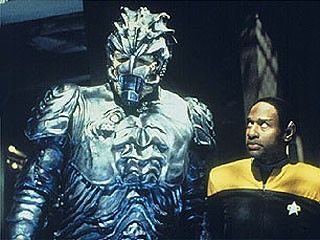
Across multiple Voyager episodes — particularly "Hunters," "Prey," and "The Killing Game" — Voyager's crew is menaced by the Hirogen, a species of alien hunters deliberately designed to be physically overwhelming.
Creator Brannon Braga was inspired by the sheer physical scale of NFL football players, and instructed the casting department to find actors at least 6'6" tall. The two largest Hirogen actors were Tiny Ron at 7'1" and Roger Morrissey at 7'4". The costumes were engineered with heavy silicone padding to give even the smaller actors a hulking, muscle-packed physique that dominated every frame they appeared in.
The Hirogen exist to make Voyager's crew — and particularly Seven of Nine and Janeway — feel small. That's the entire dramatic function of their size. They are predators who tower over their prey, and the power dynamic is coded into every shot.
The Films: Scale at the Cinema
Star Trek: The Motion Picture (1979) — V'Ger
The first Star Trek film delivers size fantasy on a truly cosmic scale. V'Ger — revealed to be NASA's ancient Voyager 6 probe, now evolved into a living machine entity — is almost incomprehensibly vast. The entity itself is estimated at around 78 kilometres in length, wrapped in an energy cloud measuring 82 astronomical units across — large enough to engulf the entire solar system.
The famous flyover sequence, in which the Enterprise travels alongside V'Ger's outer hull for what feels like forever, is a meditation on scale difference. The ship is a speck. The crew are sub-atomic. The sequence was actually cut for time from the original theatrical release because audiences found it too long — which is saying something for a scene about the vertigo of extreme size difference.
The Newer Shows: The Tradition Continues
Star Trek: Lower Decks — "Of Gods and Angles" (Season 5, 2024)
Lower Decks, with its love of obscure franchise lore, revisited the "Who Mourns for Adonais?" mythology by introducing Ensign Olly — a character descended from Zeus and a human woman. The episode plays directly with the size and power dynamics of the Greek god mythology, complete with a fifty-foot skeleton of Spock as background scenery.
Star Trek: Prodigy — "A Tribble Called Quest" (Season 2, 2024)
Prodigy brought back the giant tribble concept — this time with teeth. A Klingon scientist accidentally creates enormous, carnivorous, planet-ravaging tribbles. The size-change arc runs through the episode, culminating in a retrovirus that shrinks them back to their adorable, harmless normal dimensions.
The Fantasy Behind the Fantasy
What makes Star Trek such fertile ground for size-fetish themes is the franchise's fundamental preoccupation with power, perspective, and the relationship between the individual and the overwhelming.
Every good size-change episode is, at its core, about the same thing: what happens to identity, dignity, and agency when scale is taken away from you? The Doctor, shrinking in sickbay, insists on his professional dignity regardless. O'Brien, reduced to a few centimetres tall inside his own ship, still outsmarts the Jem'Hadar. Kirk, held in the palm of a giant, refuses to worship.
But the appeal for size-fetish fans runs deeper than the plot. It's the visual poetry of the enormous and the tiny sharing the same space. The Hirogen looming over Seven of Nine in a corridor. The tiny Rubicon creeping through the Defiant's plasma conduits. Q's vast face peering into the Voyager viewport at the people he's reduced to trinkets. Apollo's hand closing around a starship like a child picking up a toy.
These are images that the franchise has returned to — consciously and unconsciously — for over fifty years. They're not going away.
Starfleet may be boldly going where no one has gone before. But size fantasy? That's been there all along.
Want more content like this? Explore shrinkingmen.com for original stories, audio, art packs, and videos celebrating size-difference fantasy in all its forms.
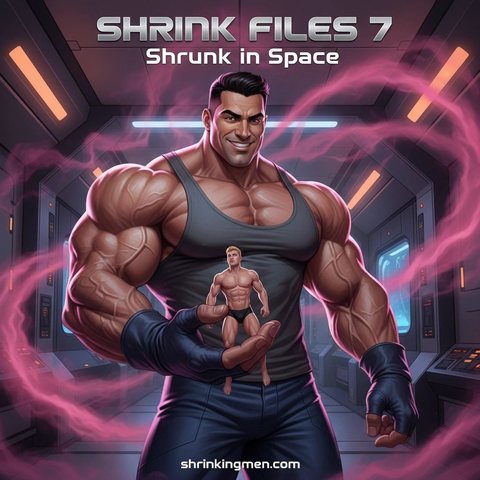
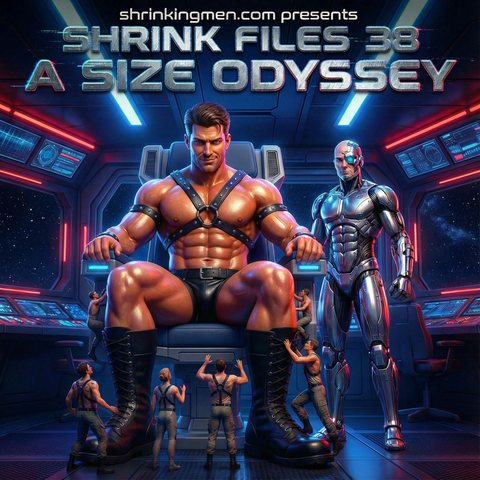
If the idea of men shrunk aboard a spacecraft speaks to you, our original sci-fi size stories scratch exactly that itch: Shrink Files Issue 7: Shrunk in Space and Shrink Files Issue 38: A Size Odyssey are both available now in the Shrinkingmen.com store.