The Science of Shrinking: Could 'Diminished' Really Happen?
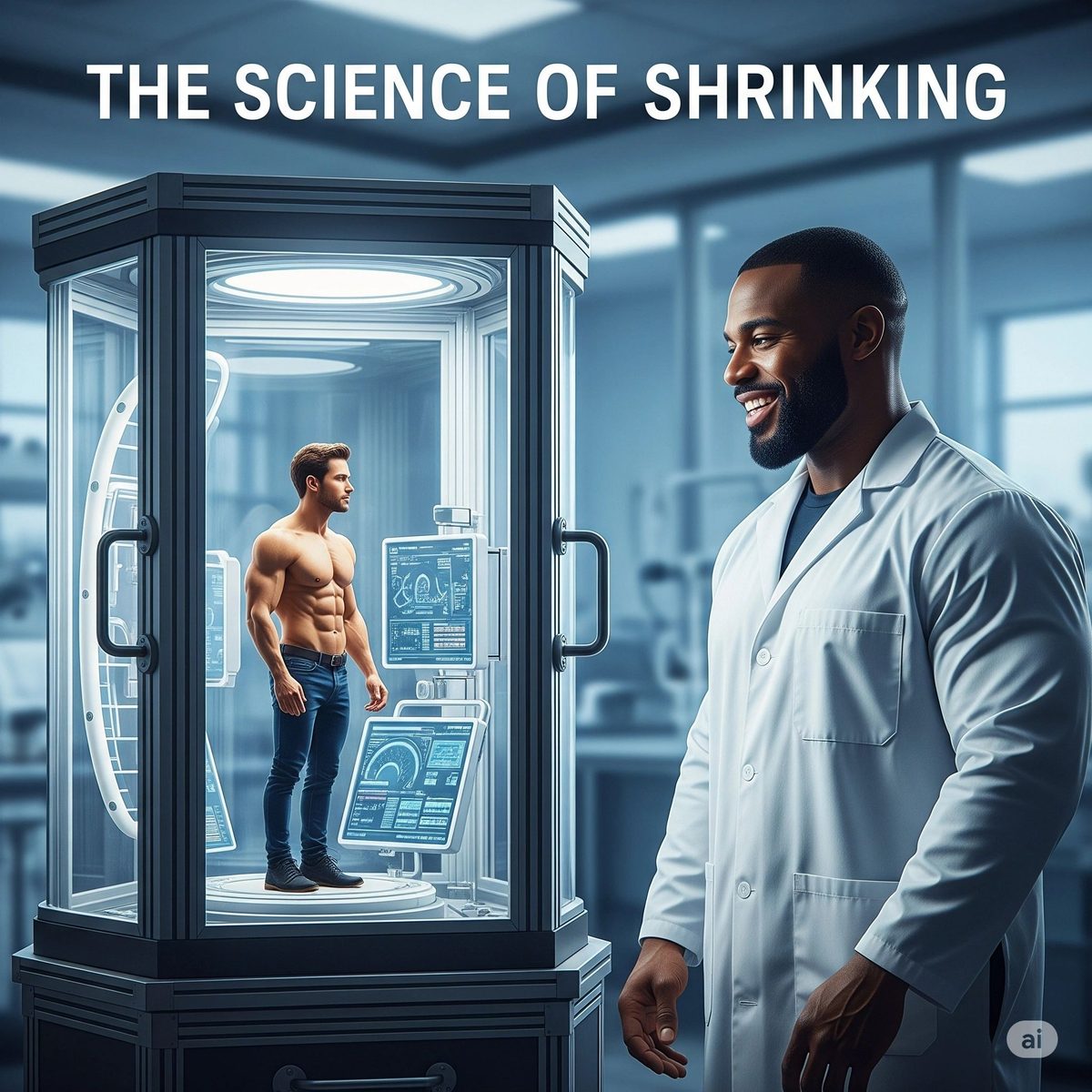
What if your wildest size-difference fantasy could cross into reality? For gay men who crave the thrill of macrophilia and microphilia – being a towering giant or a helpless inch-high plaything – the idea of actual human shrinking is the ultimate kink. It’s the stuff of erotic dreams: domination and humiliation taken to a literal new scale. But could science ever turn Honey, I Shrunk the Kids into Honey, I Shrunk My Boyfriend? In the new novel and audio series DIMINISHED, one sadistic game show does exactly that – using pseudo-plausible science to make men tiny. The premise is tantalizing and terrifying: one hundred men volunteer to be progressively miniaturized for a chance at $200 million, bringing size fetish fantasies to life with disturbingly real detail.
In this article, we’ll explore the seductive concept of shrinking a human being from both the DIMINISHED in-universe perspective and real-world science. Prepare for a journey that’s equal parts sexy and smart – from the fictional Size Reduction (SR) technology that powers the carnage in DIMINISHED, to the hard physics and biology that say “not so fast”. By the end, we’ll answer the burning question: could DIMINISHED actually happen, or is this one fantasy that will (fortunately or unfortunately) remain fiction?
The SR Process in DIMINISHED: Science Fiction with a Kinky Twist
In the world of DIMINISHED, human shrink tech isn’t magic – it’s framed as cutting-edge science. Host Alexei Kaine introduces contestants to the SR-Series Dimensional Reduction Platform, a fusion of biotech and “quantum compression” technologies. Contestants step into transparent high-tech SR booths, where a blue, pulsating glow surrounds them like something out of a futurist’s wet dream. With a mechanical countdown and blinding flash, their bodies are compressed at the molecular level. Every cell, every atom, is squeezed closer together uniformly – “as if being compressed in a vise that acted on every cell”. The result? The men walk out physically smaller but otherwise intact, having literally been shrunk.
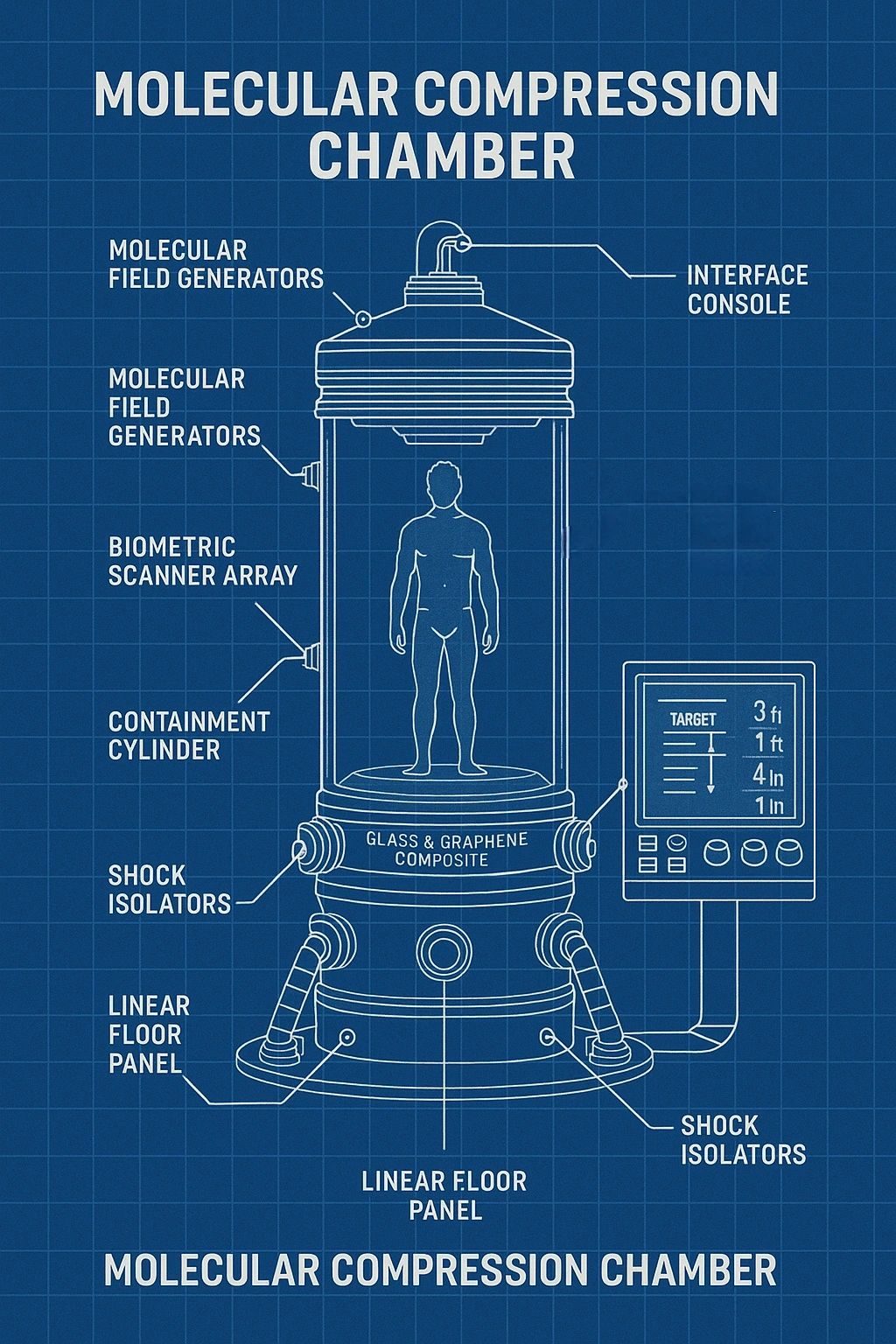
How does it (supposedly) work? Dr. Chen, the chief scientist in DIMINISHED, explains that the process “compresses your molecular structure while maintaining proportional integrity”. In plain terms, the SR tech decreases the distance between molecules (or even between subatomic particles) without altering the men’s basic anatomy. Contestants’ mass is reduced along with volume, preventing them from becoming super-dense little rocks. In fact, the novel suggests mass decreases proportionally to size – meaning a man at 50% height (about 1/8 of his original volume) weighs roughly 1/8 of what he did before. This avoids turning a 200-pound man into a 200-pound six-inch figurine, which would be an absurdly heavy nugget of flesh. The trade-off, of course, is that the “lost” mass (and the colossal energy bound up in it) has to go somewhere. Kaine’s team hints at astronomical power requirements to achieve this feat. The SR system likely converts the excess mass to energy or shunts it into some higher-dimensional pocket – hand-wavy science, but it gives a veneer of credibility. Contestants even receive a “preparatory injection” the night before shrinking, a cocktail of biotech enhancements that helps their bodies survive the trauma of molecular compression. We see its effects when one unlucky man convulses from organ failure right after Stage One reduction, showing that not every body can handle being suddenly diminished.
Importantly, the SR process in DIMINISHED works on everything within the field, not just living tissue. Clothing and objects shrink too, as Dylan discovers when his tight bodysuit fits his new three-foot frame perfectly. This suggests a sci-fi field effect – perhaps a controlled manipulation of the Higgs field or a localized distortion of space. In the DIMINISHED lore, the technology was secretly developed under a NATO program (tellingly codenamed Project Latchkey) to non-lethally subdue enemies by miniaturizing them. Kaine repurposed this black-ops science for his extreme fetish game show, or as one character puts it, “He eroticised the hardware”. The result is SR: a blend of quantum physics and biotechnology that turns men into toys. It’s a sexy idea precisely because the story makes it sound almost plausible. But how does it stack up against real science?
Real-World Physics: Why Shrinking a Human Is (Almost) Impossible
The fetish fantasies of DIMINISHED are grounded in the notion that, given the right tech, humans can be greatly reduced in size. Real-world science, however, throws several big buckets of cold water on that hot idea. Let’s break down the major scientific hurdles of human miniaturization, from quantum physics to biology:
- You Can’t Shrink Atoms (Quantum Field Theory Constraints): The human body is made of ~7 octillion atoms, and atoms themselves refuse to shrink under normal physics. An atom’s size is fixed by fundamental constants – things like the electric charge of the electron and Planck’s constant set the scale of electron orbitals. You can’t just squeeze the electron “cloud” closer to the nucleus without rewriting the rules of quantum mechanics. Roger Moore, a U of A physicist, explains that shrinking a person would require breaking “essentially unbreakable” laws of physics, like altering the speed of light or Planck’s constant. In other words, unless you have a gadget that can hack the fundamental constants of the universe, you’re out of luck. A science article for Astronomy magazine puts it succinctly: all those atoms in a human body “would have to cram into a space the size of one atom” if you truly shrank to atomic scale, and “there’s no way to do that” without changing physics as we know it.
- Energy and Mass Balance: Suppose, like in DIMINISHED, you try to compress a human’s matter without violating quantum laws (perhaps by a sci-fi method of folding space or using some “quantum compression field”). The next nightmare is energy. Compressing matter or removing mass invokes Einstein’s $E=mc^2$ in a big way. Even shrinking a person by 50% height (which cuts volume to 1/8) would require converting a huge chunk of their mass to energy or otherwise disposing of it. The energy release from shrinking a 70 kg man to even half size could be on the order of nuclear bomb yields if not perfectly captured and controlled. DIMINISHED acknowledges this challenge through a character (a biochemical engineer) who stammers that the “energy requirements alone would be—far beyond conventional capabilities”. In the novel, the evil genius Kaine somehow has that power source, but in reality we do not. As one ex-NATO scientist in the story remarks, “The energy requirements were astronomical, and we never got past theoretical models”. Any realistic shrink-ray would need an unfathomable amount of energy and likely produce dangerous radiation or heat as a byproduct. One could imagine a future fusion reactor or matter-antimatter generator powering such a device – but that’s deep into speculative territory.
- Density and Material Structure: Let’s say by some miracle you could squeeze a person’s atoms closer. You then face the density problem. If you don’t remove mass, a shrunken human would become as dense as osmium or even a neutron star. Imagine a 6-foot man weighing 180 lbs compressed down to 6 inches but still 180 lbs – he’d punch through the floor! Ant-Man comics get around this by claiming the hero retains his mass when small (resulting in heavy punches), but that’s pure fantasy. In reality, density can’t just arbitrarily increase without crushing the very chemistry of life. DIMINISHED smartly avoids this by reducing mass along with size, as Dr. Chen describes. But removing mass means literally annihilating matter or storing it elsewhere. The Astronomy article above notes a “shrunken human would be unimaginably dense” if all atoms stayed – the only fix would be to “alter the fundamental constants” to make atoms themselves smaller. Some sci-fi scenarios propose shunting mass into another dimension or parallel universe (a favorite trick in comic books), but that’s not science we can test – it borders on magical thinking.

- Nanotechnology to the Rescue? Perhaps we can cheat the whole problem by rebuilding a person at smaller size instead of literally shrinking the same atoms. This is where nanotech futurism comes in. In theory, super-advanced nanorobots could disassemble a human body atom-by-atom and reassemble a miniature version (or even just build a tiny clone from raw materials). But this is essentially teleportation or copying, not shrinking the original continuous being – and it would kill the person in the process unless mind-uploading is also a thing. More plausibly, nanotech could augment a person to function better if somehow shrunken. For instance, nanomedical devices could take over vital tasks that fail at small scale. Notably, Robert Freitas (a pioneering nanotechnology theorist) proposed artificial respirocytes – nano-scale oxygen carriers that could supply 236 times more oxygen than natural red blood cells. In a shrink-scenario, something like respirocytes might be necessary to keep a tiny body oxygenated. DIMINISHED’s injection could well contain such nanomachines, fortifying organs and boosting oxygen delivery for the downsized contestants. Likewise, nanotech could strengthen bone and tissue or regulate body temperature in the absence of normal physiology at micro-scale. These ideas show that nanotechnology might solve some problems (breathing, circulation) – but they still don’t solve the core physics of making a human smaller. At best, they’d help a shrunken person survive longer.
- Biological Limits: Oxygen & Metabolism – Beyond physics, a miniaturized human faces serious biological hurdles. One is oxygen diffusion. Our lungs work because millions of alveoli provide a huge surface area for gas exchange. If you scale a person down, lung surface area plummets, and the amount of oxygen that can diffuse into blood may become critically low. According to quantum scientist Chris Ferrie, if you shrank to even 1/1000 of your volume, your cells might suffocate – “the amount of oxygen they could intake would be drastically reduced”. Insects survive at small sizes partly because they have different respiratory systems (direct air tubes) and because their oxygen needs are met by passive diffusion in an oxygen-rich environment. A tiny human with human-like lungs might simply not get enough O$_2$ per breath. You’d need measures like enriched oxygen or those nanotech respirocytes to cope. Similarly, metabolic rate is a concern. Smaller creatures burn energy faster (per unit mass) than larger ones – a mouse’s heart races around 500 beats per minute, for example, while an elephant’s is ~30 bpm. This is due to the square-cube law: small bodies have a high surface-area-to-volume ratio, losing heat rapidly and requiring a “hotter” metabolism. A shrunken man might have to eat nearly constantly or go into a torpor to avoid starving or freezing. In DIMINISHED, we see contestants struggle with bursts of high exertion and stress at small sizes, and presumably the facility keeps them in a climate-controlled environment. The book even hints at altered sexual responses at reduced size – indeed, some men in the story experience euphoria or heightened arousal during/after shrinking. That could be partly psychological, but who knows, maybe the hormonal and neurological shock of resizing could trigger bizarre side effects. The bottom line: biology doesn’t like being miniaturized. Evolution optimized our organs for human-scale physics. Past a certain reduction, things start breaking down – cells don’t get oxygen, organs don’t function, and the immune system, nervous system, and everything else go haywire.
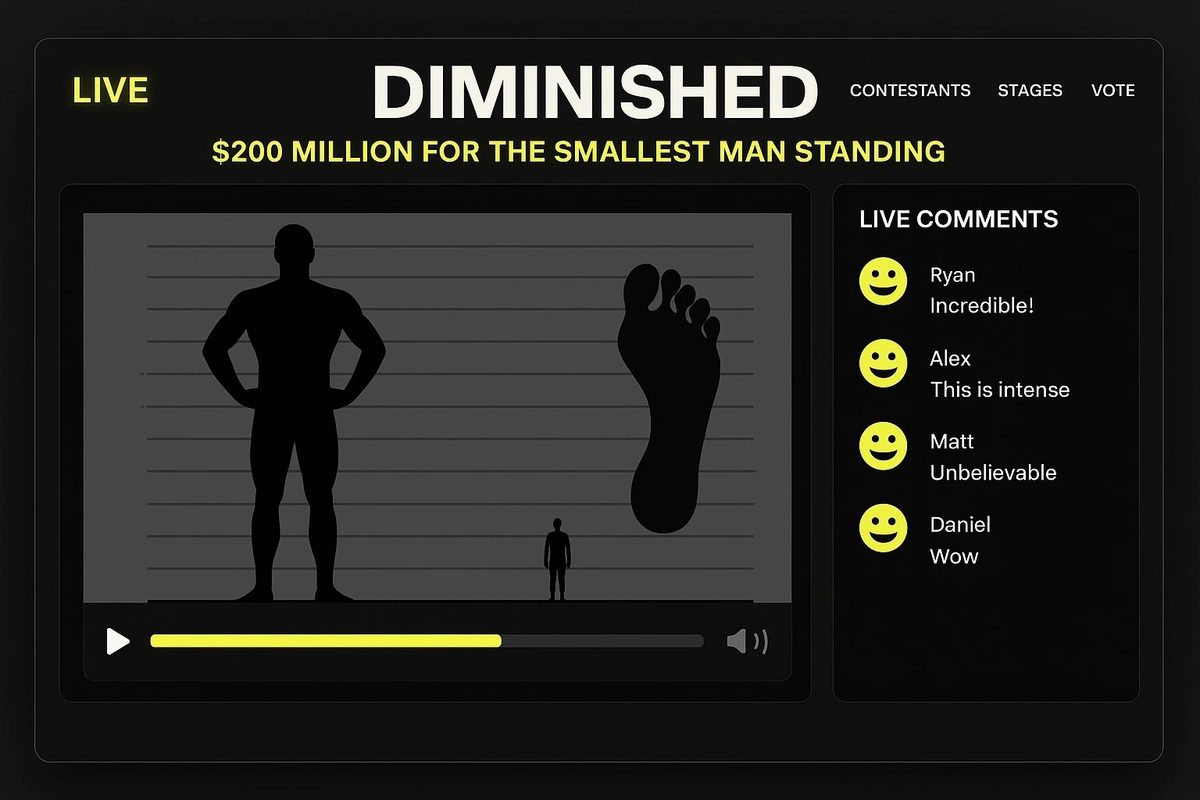
To sum up the science: current physics and biology emphatically say that shrinking a human is not possible with any technology we have or foresee in the near future. As one physicist put it, “you cannot shrink atoms… it may make for a fun science fiction story, but it’s almost entirely fiction, with little to no science”.
And yet, that very impossibility is part of the fetish’s allure. The fact we can’t do it – that a man can’t really be reduced to a helpless inch-tall toy – is what keeps it safely in the realm of fantasy where it can be erotic. DIMINISHED cleverly straddles that line: it uses just enough real science terms (quantum, molecular compression, nanotech) to suspend your disbelief, all in service of some seriously kinky power-play scenarios.
So, Could DIMINISHED Ever Be Real? (A Sexy Speculation)
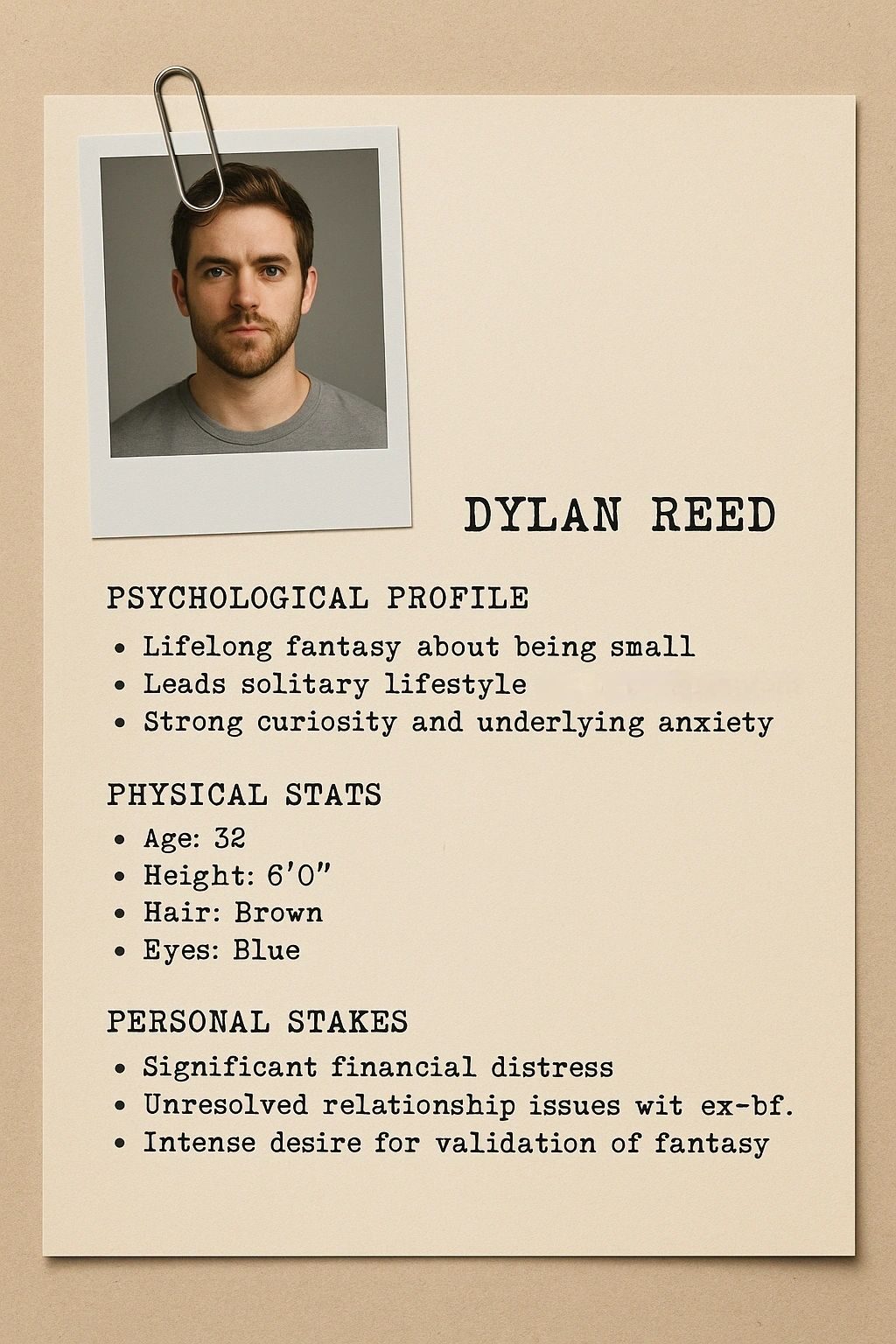
Given everything we know, the likelihood of actual size reduction in our lifetime is extremely low. We would need a breakthrough akin to discovering fire or inventing the airplane – but even more revolutionary, because we’d be breaking the fundamental limits of matter. Shrinking people would require science so advanced it might as well be magic by today’s standards. Quantum field theory, as it stands, prohibits it. Engineering-wise, it’s hard to imagine a safe method to remove or store mass on that scale, or a way to keep a tiny person alive and healthy.
However, part of the fun in speculating is to ask “What if…?” What if a billionaire madman like Alexei Kaine in DIMINISHED did pour unlimited resources into researching human miniaturization? They might explore exotic theories: perhaps using high-frequency lasers or particle fields to literally squeeze the space between atoms, or Higgs boson manipulation to reduce mass, or even harnessing hypothetical extra dimensions as a dumping ground for matter. These ideas flirt on the edge of science fiction’s wildest dreams. Could a real Dr. Evil achieve a one-inch man? Almost certainly not with any known physics – but maybe they could achieve a partial shrink. For instance, nanotechnological body modification could, in theory, make a person functionally smaller: imagine altering someone’s biology to have hummingbird-like metabolism, then surgically reducing limb lengths, etc. That’s not shrinking so much as radical body sculpting. Not very erotic, perhaps, but it shows how far we are from the effortless, reversible shrinking depicted in DIMINISHED.
Where Fantasy Meets Reality – DIMINISHED Awaits
In the end, the science of shrinking tells us that DIMINISHED is firmly fiction – but it’s the feel of reality that makes it so provocative. By weaving real scientific concepts (quantum fields, nanotech, bioengineering) into a fetish scenario, DIMINISHED creates an experience that is both erotically charged and intellectually stimulating. It tickles that part of the brain that says, “This could almost happen… and that makes it even hotter.”
For those of us who fantasize about giant men and tiny men, about absolute domination and surrender, DIMINISHED offers the ultimate narrative: 100 men, 4 stages of shrinking, 1 survivor. It’s a story that doesn’t shy away from the dark, taboo extremes of macrophilia – from feet crushing little bodies to voracious giants swallowing men whole – yet it anchors these kinks in a high-tech premise that feels eerily credible. It’s sexy, it’s scary, and it’s smart.
So, could DIMINISHED happen in real life? Almost certainly not – but the idea that it could is a huge part of why it turns us on. And that’s the real science of shrinking fantasies: they excite us because they blend the impossible with the possible.
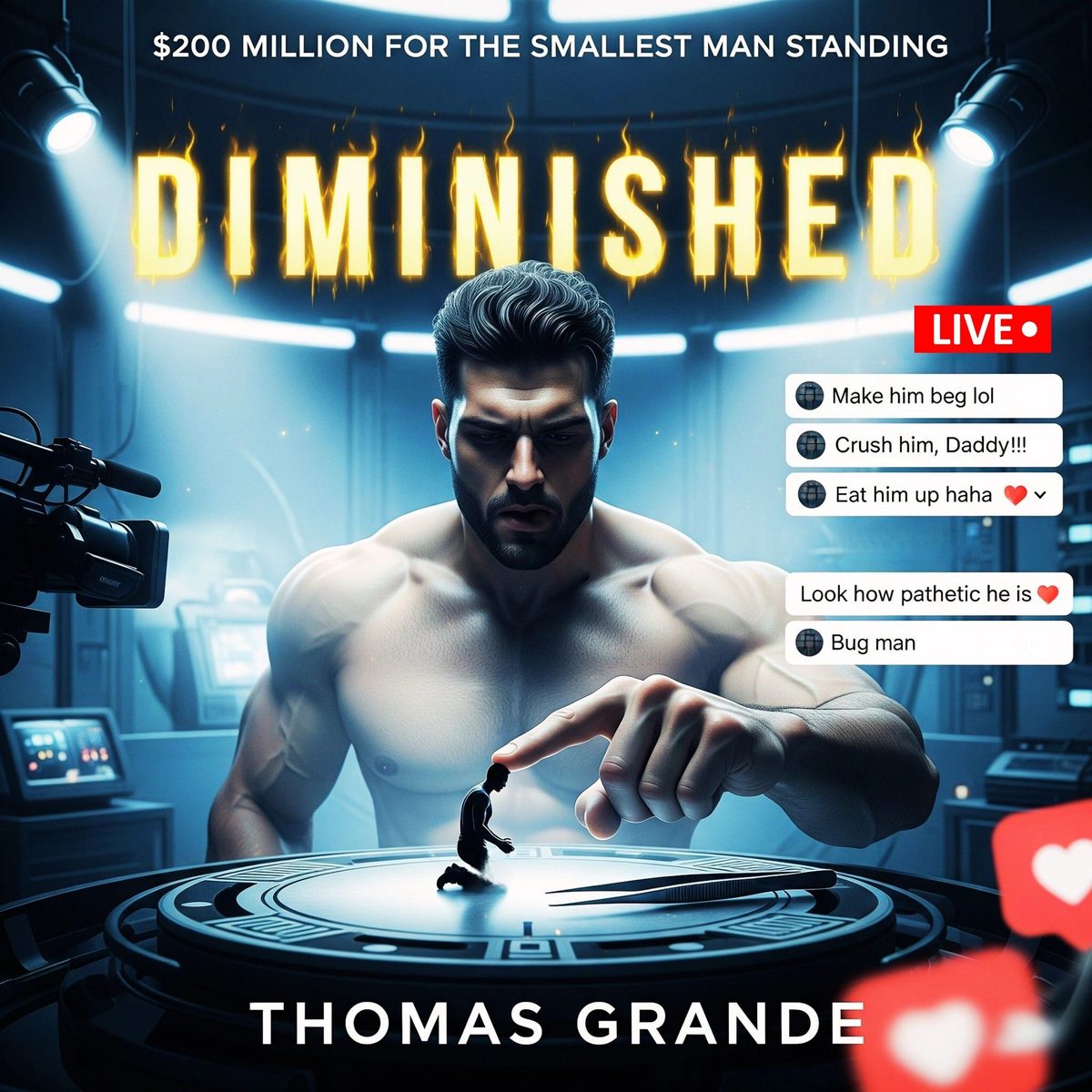
Ready to step into the SR booth yourself? While we can’t offer that (thank goodness!), you can dive into the world of DIMINISHED to live out this fantasy safely through fiction. The novel and its immersive audio series are available now, so you can witness every erotic, science-fueled twist and turn of the game. Indulge in the ultimate size-difference adventure – read or listen to DIMINISHED today, and experience the arousal, the domination, and the disturbingly real-seeming science for yourself. Let your imagination run wild… just remember to come back to reality at full size when you’re done!
Sources: Real-world scientific insights on the feasibility of human shrinking and the physiological challenges were drawn from physics and biology experts. In-universe details of the SR process are based on Thomas Grande’s DIMINISHED, which innovatively blends speculative science with fetish fantasy. Further reading on fundamental limits of miniaturization can be found in discussions of Ant-Man’s physics and analyses by quantum theorists. Nanotechnology concepts such as Freitas’s respirocytes illustrate how future tech might assist a shrunken human, even if we can’t achieve the shrinking itself. The seductive allure of DIMINISHED lies exactly in this intersection of fact and fiction – a place where our rational mind and our kinkiest fantasies meet. Enjoy the science, enjoy the fantasy, and happy reading/listening!